

TL;DR
India has introduced a fully digital OCI Card (Overseas Citizen of India Card) for all new OCI applicants. Existing physical OCI cards remain valid, but future OCI cards will only be issued in digital format. The e-OCI Cards are the new update. The biggest change is that mandatory OCI card renewals at ages 20 and 50 have been removed. Instead, cardholders simply need to update their passport details online whenever they receive a new passport.
However, there are two important rules to remember:
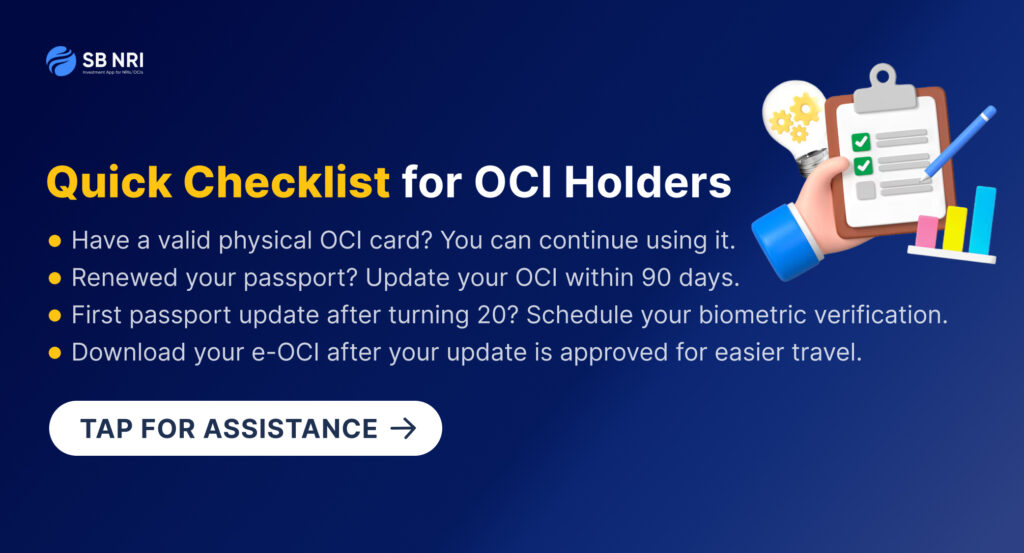
- Update your new passport details within 90 days of passport issuance.
- If this is your first passport update after turning 20, you must complete a one time biometric verification.
For millions of NRIs and OCI cardholders, this is one of the biggest simplifications to the OCI system in years.
India Has Finally Modernized the OCI System
If you’ve ever renewed your passport as an OCI cardholder, chances are you’ve wondered:
“Do I need a new OCI card?”
Until now, the answer often involved confusing age based rules, physical booklet reissuance, paperwork, and long processing times.
That changes in 2026.
The Government of India has officially launched the e-OCI Card, replacing physical issuance for all new OCI applications and introducing a much simpler digital system for existing cardholders. The objective is straightforward: reduce paperwork, simplify updates, improve security, and make international travel easier for the global Indian diaspora.
If you’re an NRI, OCI cardholder, or planning to apply for OCI soon, here’s everything you need to know.
Already Have a Physical OCI Card? Here’s What You Need to Do
If you’ve held an OCI card for years, there’s no need to panic or rush into a new application.
The Government of India has clarified that all valid physical OCI cards continue to remain valid. You can continue using your existing OCI booklet for international travel, immigration, banking, property transactions, and other services where an OCI card is accepted.
Here’s what this means in practice:
| If you… | You need to… |
| Already have a valid physical OCI card | Nothing immediately. Your card remains valid. |
| Renew your passport | Update your passport particulars online within 90 days. |
| Want the convenience of a digital copy | Download your e-OCI from the OCI portal after your details are updated. |
| Are applying for OCI for the first time | You’ll receive only the digital e-OCI under the new system. |
Think of the e-OCI as a digital upgrade rather than a replacement exercise. Existing physical cards are not being cancelled or invalidated, and there is currently no requirement to exchange them solely because the government has introduced digital issuance.
The only time you’ll need to take action is when your passport or personal particulars change, or if you’re completing the one time biometric requirement after turning 20.
What Is the New e-OCI Card?
The e-OCI Card (Electronic Overseas Citizen of India Card) is the digital version of the traditional OCI booklet.
Instead of waiting for a physical booklet to be printed and shipped, eligible applicants receive a secure digital OCI card that can be stored on a mobile phone or other device.
The e-OCI is integrated with India’s immigration systems and can be presented digitally, together with a valid foreign passport, during international travel.
When Did the New Rules Come Into Effect?
The rollout happened in two stages:
| Date | Update |
| 30 June 2026 | Government launched the e-OCI platform. |
| 8 July 2026 | Only digital e-OCI cards began being issued for all fresh OCI applications. |
Existing physical OCI cards continue to remain valid. There is no requirement to replace them immediately.
What Has Changed?
Here is a quick comparison.
| Earlier System | New Digital System |
| Physical OCI booklet issued | Digital e-OCI issued for new applications |
| OCI reissuance required after turning 20 and 50 | No age based reissuance required |
| Passport updates often meant applying for a fresh card | Passport details updated online |
| Physical booklet needed during travel | Digital e-OCI can be presented with passport |
| More paperwork and courier delays | Digital processing and downloads |
This significantly reduces administrative work for both applicants and the government.
Are Existing Physical OCI Cards Still Valid?
Yes.
If you already have a physical OCI booklet, it remains completely valid.
You do not need to surrender it or apply for a replacement simply because the government has introduced digital OCI cards.
However, existing cardholders are encouraged to generate and download their e-OCI card for easier travel and verification.
The Biggest Relief: No More Mandatory OCI Renewals at 20 or 50
This is arguably the most important update.
Previously, OCI holders had to apply for a fresh OCI card after:
- Turning 20 years of age
- Turning 50 years of age
These age based renewals often caused confusion and unnecessary expenses.
Under the new framework:
You no longer need to apply for a fresh OCI card solely because you turned 20 or 50.
Instead, you simply update your passport details online whenever you receive a new passport.
What Still Needs to Be Updated?
Although card renewals are gone, keeping your OCI record updated is still your responsibility.
You should update your OCI profile if you have:
- A new passport
- A change in name
- A change in nationality
- A change in personal particulars
- Updated address or occupation, where applicable
These updates are completed through the OCI Miscellaneous Services portal.
The New 90 Day Rule
One rule that every OCI holder should know is the 90 day passport update requirement.
After receiving a new passport, you should update your passport particulars on the OCI portal within 90 days.
Failure to do so may attract a US$25 late penalty under the new framework.
If you frequently renew passports because of visas or changing residency status, it is worth setting a reminder so you do not miss this deadline.
Do You Still Need Biometrics?
Sometimes.
The digital system removes most physical visits, but one important exception remains.
If you are updating your passport details for the first time after turning 20 years old, you must complete biometric verification.
This is a one time requirement and can generally be completed at:
- An Indian Mission or Embassy
- A Foreigners Regional Registration Office (FRRO) in India
- An approved immigration checkpoint during your next arrival in India, where available under the notified process
Once completed, future updates are expected to remain largely digital.
How to Download Your e-OCI Card
If you’re already an OCI cardholder, you can generate your digital card online.
The process is simple:
- Sign in to the OCI Services Portal.
- Register or log in using your OCI credentials.
- Open your dashboard.
- Select the e-OCI Card section.
- Generate your digital card.
- Download and save it securely on your phone or computer.
Once generated, the e-OCI card can be presented digitally during travel together with your passport.
Who Benefits the Most?
The new system of Digital OCI cards is especially useful for:
- NRIs who frequently renew foreign passports
- Families with children holding OCI cards
- Frequent international travellers
- OCI holders living far from Indian embassies
- Professionals who previously needed courier services and physical booklet replacements
By reducing mandatory renewals and moving updates online, the government has removed one of the most common sources of OCI confusion.
Common Questions NRIs Are Asking
Many OCI holders are understandably wondering whether they need to take any immediate action.
In most situations:
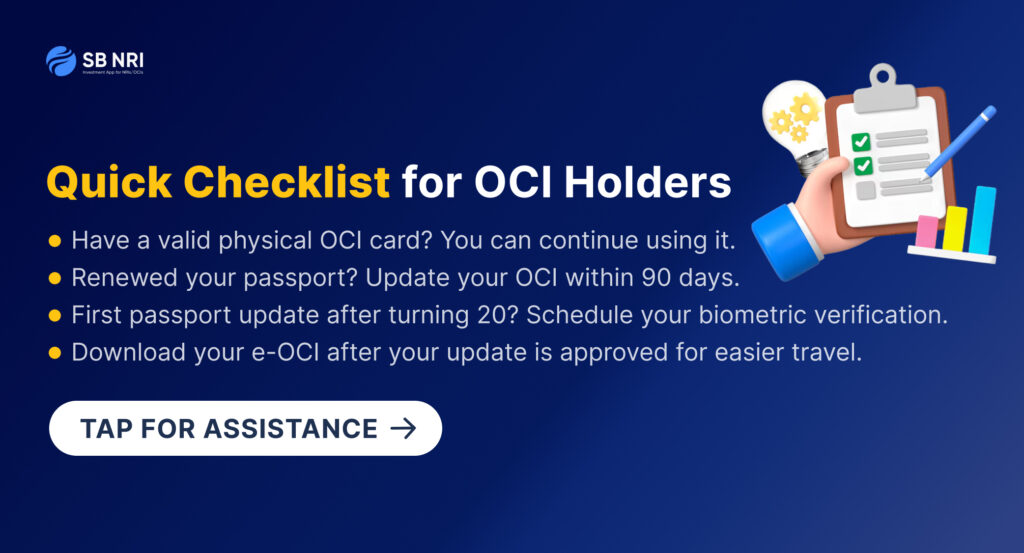
- If your physical OCI card is valid, you can continue using it.
- You may download the e-OCI version for convenience.
- If you receive a new passport, remember to update your passport details within 90 days.
- If it is your first passport update after turning 20, plan for the required biometric verification.
Also read: How can OCI Card Holders invest in India?
Final Thoughts
India’s transition to digital OCI cards is one of the most significant improvements to the OCI program in recent years.
For most cardholders, the changes mean:
- Less paperwork
- No more routine age based renewals
- Faster online updates
- Easier international travel
- Better integration with immigration systems
That said, OCI holders should not assume that no action is ever required. Keeping passport details updated on time remains essential, and missing the 90 day deadline could result in penalties.
If you hold an OCI card and recently renewed your passport, now is a good time to review your OCI records and ensure everything is up to date.
FAQs
1. Do I still need my physical OCI booklet?
No. Existing physical OCI cards remain valid, but you can also use the digital e-OCI card along with your valid passport for travel and immigration verification.
2. Do I need to renew my OCI card after turning 20 or 50?
No. The mandatory age based reissuance requirement has been removed. Instead, update your passport details online after receiving a new passport.
3. What happens if I don’t update my passport details within 90 days?
A late fee of US$25 may apply if the update is not completed within the prescribed timeline.
4. When is biometric verification required?
Biometric verification is required when updating passport particulars for the first time after turning 20 years old. This is generally a one time requirement.
5. Can existing OCI cardholders download an e-OCI card?
Yes. Existing OCI cardholders can log in to the OCI Services Portal, generate their e-OCI card, and download it for future use.


