

Union Budget 2026 for NRIs marks one of the most important policy shifts in recent years. Instead of focusing only on tax rate changes, the Budget focuses on ease of compliance, voluntary disclosure, reduced litigation exposure, and smoother cross-border taxation.
For Non-Resident Indians, Returning Indians, RNOR taxpayers, overseas professionals, and global investors, Union Budget 2026 introduces practical solutions to long-standing challenges. These include foreign asset disclosure complexity, Liberalised Remittance Scheme taxation, Income Tax Return correction flexibility, property sale compliance, and exposure under the Black Money Act.
The broader policy direction is clear. India is moving toward a trust-based, digitally enabled, globally aligned tax system, where compliance is simpler, faster, and more predictable.
1. LRS TCS Reduction: Lower Remittance Tax Burden for NRIs
One of the most practical benefits under Union Budget 2026 for NRIs comes from the rationalization of Tax Collected at Source (TCS) under the Liberalized Remittance Scheme.
Earlier, higher TCS rates created significant cash flow blockage. Many families had to file Indian tax returns purely to claim refunds.
Under Budget 2026:
- Education remittances → 2% TCS (earlier 5%)
- Medical remittances → 2% TCS (earlier 5%)
- Overseas tour packages → Flat 2% TCS without threshold
This directly improves liquidity and reduces refund dependency for global Indian families.
👉 Download the SBNRI App to start investing in Indian Mutual Funds
2. Extended ITR Revision Timeline: More Time to Correct Tax Filings
Managing Indian tax filings while living overseas is complex. Union Budget 2026 for NRIs introduces meaningful flexibility.
The time limit to file belated or revised Income Tax Returns has now been extended to 31 March, compared to the earlier 31 December deadline.
In addition, updated returns can now be filed even after reassessment proceedings begin, subject to additional tax. This gives NRIs a structured correction window without immediate litigation risk.
3. FAST-DS 2026: One-Time Foreign Asset Disclosure Opportunity
The Foreign Assets of Small Taxpayers Disclosure Scheme (FAST-DS 2026) is one of the biggest compliance opportunities introduced under Union Budget 2026 for NRIs.
The scheme allows voluntary disclosure of foreign income or assets with defined tax payments and immunity from prosecution.
This is especially relevant for NRIs holding:
- Foreign bank accounts
- Overseas brokerage accounts
- Global stocks, ETFs, or mutual funds
- RSUs and ESOPs from foreign employers
👉 Download SBNRI App for NRI Mutual Fund Investing
4. Black Money Act Relief for Small Foreign Assets
Budget 2026 introduces relief for small foreign asset holdings. Foreign assets (excluding immovable property) up to ₹20 lakh will not attract penalty or prosecution.
This is particularly beneficial for NRIs who still hold small overseas savings accounts, dormant brokerage accounts, or legacy foreign investments.
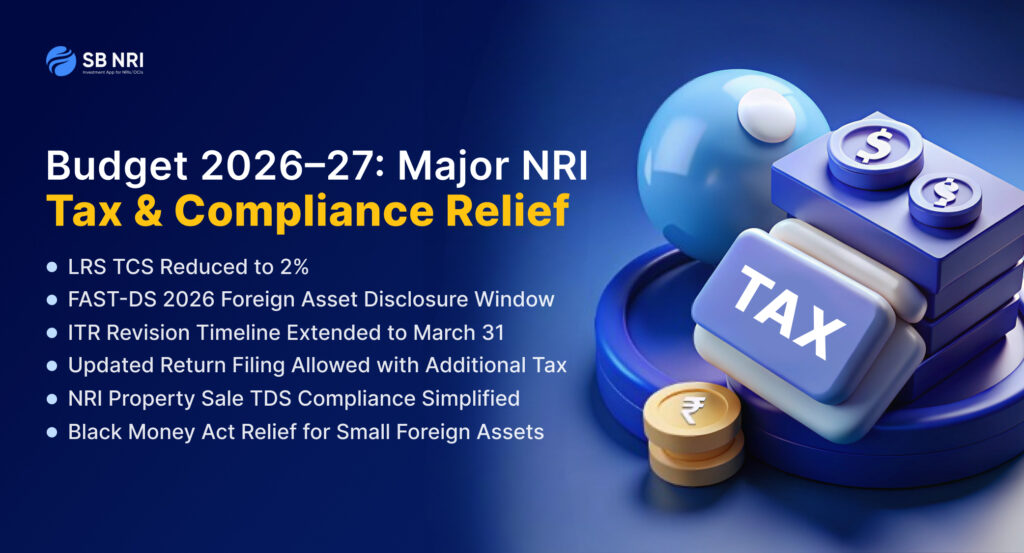
5. Simplified TDS Rules for NRI Property Sales
Earlier, buyers needed TAN to deduct TDS while purchasing property from an NRI seller. Under Budget 2026, buyers can now deposit TDS using PAN-based challans.
This improves transaction timelines, reduces compliance complexity, and enables smoother repatriation of sale proceeds.
6. Reduced Litigation and Decriminalisation of Technical Defaults
Budget 2026 signals a shift toward trust-based taxation. Several technical defaults are now being converted into fee-based non-compliance instead of criminal penalties.
For NRIs, this reduces prosecution fear and provides more predictable compliance outcomes.
7. Other Key Compliance Simplifications for NRIs
Additional improvements include digital filing enhancements, simplified prosecution frameworks, clarity on MAT applicability for certain non-residents, and global income exemptions for specific foreign professionals working in India.
👉Also, read: Union Budget 2026: Key NRI Tax and Investment Takeaways
Conclusion: Why Union Budget 2026 for NRIs Is a Compliance Reset Opportunity
Union Budget 2026 for NRIs represents a structural reset in cross-border tax compliance. It encourages voluntary foreign asset disclosure, reduces litigation risk, simplifies remittance taxation, and makes property transactions smoother.
For NRIs and returning Indians, this is a rare opportunity to correct historical compliance gaps and align with global tax reporting frameworks.


